Under review, ICRA 2027

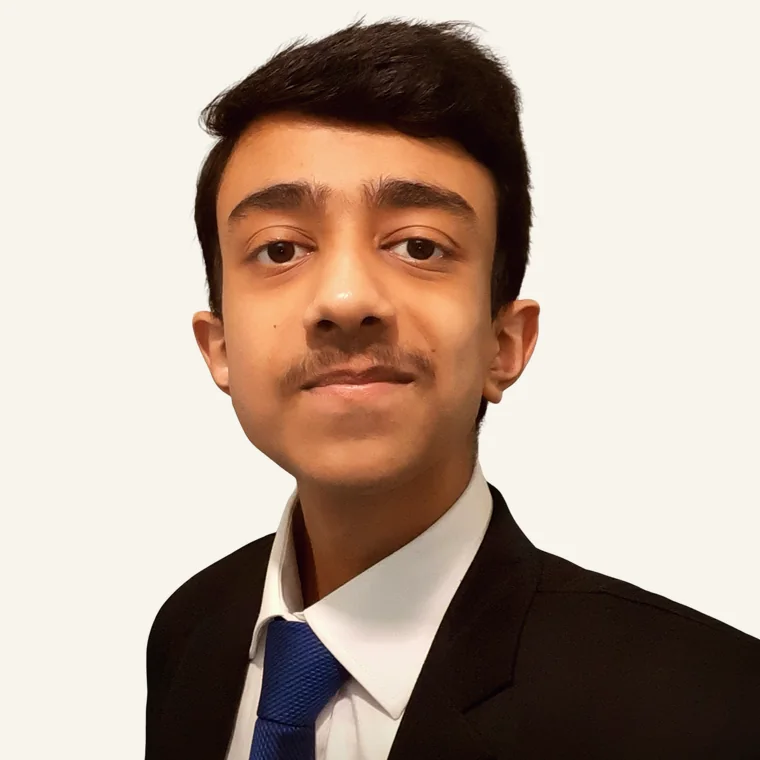
Hussain Habib.

I work on perception for machines that have to act on what they see. One project sends a fleet of ground robots into a building nobody gave them a map of. Another learns to predict how a plant will grow, and how many leaves it will have, from the way it looks today.

Hive-Nav

Drag to orbit. Click a room to jump there

Interactive floor model needs WebGL

Agri-JEPA

Drag to orbit. Translucent domes are forecasts

Interactive plot model needs WebGL

01 Current research

Two systems that have to act on what they see.

One drives a fleet of robots through a building nobody handed it a map of. The other predicts how a plant will grow from the way it looks today.

Hive-Nav

Multi-robot open-vocabulary semantic navigation. A fleet finds and classifies rooms given nothing but a natural language description, then sweeps each one for target objects.

ICRA 2027, under review ROS 2 Nav2 Open vocabulary Multi-robot

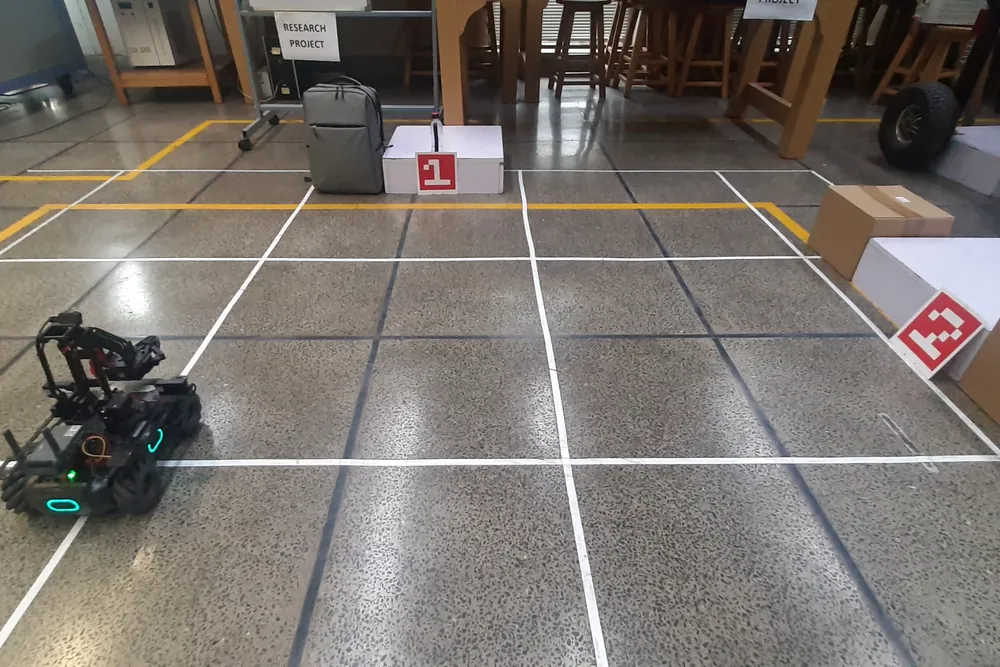
Hive-Nav coordinates a fleet of DJI RoboMaster EP Core robots across a university wing. Each robot carries a Raspberry Pi 5 and runs its own Nav2 stack. A single GPU workstation orchestrates the fleet and holds the inference models. The mission runs in two phases.

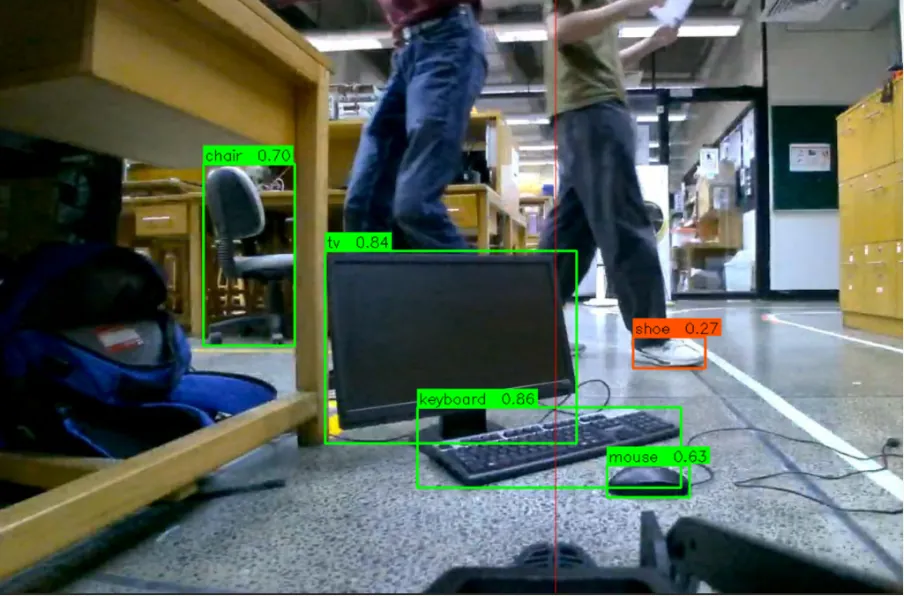
Phase 1 is semantic room classification under dynamic allocation. The workstation dispatches a room task list, and each robot measures candidate path lengths locally with ComputePathToPose. Allocation therefore reflects true reachable distance rather than straight line distance, and no planning query ever crosses the domain bridge. On arrival a robot spins in place and captures frames. The workstation classifies the room with a tiered pipeline that starts at YOLO detection and escalates to CLIP and a vision language model when tier-one evidence is weak. The allocator confirms or denies each room until the floor is resolved.

Phase 2 is coverage search. Once every room is identified, the workstation computes viewpoint waypoints per room from an open-area flood fill and streams them to the robot, which drives NavigateThroughPoses and samples frames for object detection at each pose.

Platform
RoboMaster EP Core
Onboard compute
Pi 5 per robot
Navigation
Nav2 AMCL
Sensing
RPLiDAR A2M12

Agri-JEPA

A latent world model of crop growth that has to learn from very little data. It forecasts future latent states instead of pixels, and it is trained on a pool of lab and field sources rather than one clean benchmark. The question has moved from the growth chamber to the field. Which measurements a grower or breeder can actually take are worth anchoring the model to, and what the model can tell them in return.

In progress JEPA World models Field phenotyping Small data

A small slice of the latent is supervised by a physiological anchor, such as leaf count, plant height, or leaf chlorophyll. The rest is a residual that a predictor carries forward in time. In a controlled comparison against SIGReg, both the anchor and the regulariser prevent collapse. The anchor is better on the traits it supervises, reaching an age error of 1.69 days against 1.91 to 2.46, and it needs no weight to tune.

Which anchors help in the field. Chlorophyll readings on greenhouse soil boxes cut prediction error relative to persistence from 0.44 to 0.25 in three of three seeds, and plant height on wheat plots raises held-out R squared from 0.570 to 0.665. A calendar anchor, days after planting, gives no reliable benefit across seasons. Six heterogeneous sources train under one encoder once each source's loss is normalised by its own persistence error. Pooling then matches solo accuracy and cuts seed-to-seed spread by about three times.

What it gives back. With no labels at all, clustering trajectory features recovers four wheat varieties across 20 field subplots with an adjusted Rand index of 0.89, where colour statistics, ImageNet features, and an untrained encoder reach 0.37 to 0.43. On the lab benchmark, four camera views lower held-out prediction error by 40 percent in 15 of 15 matched runs, and the gain peaks at four views.

Not everything worked, and I would rather say so here. The model does not learn a dynamics prior that transfers to a new crop without retraining. Conditioning on management actions did not help in any way I could measure. Several forecasting gains that looked good against persistence mostly disappeared once I compared against a simple clock baseline. Anyone building on this work should know where the model stops being useful.

Field anchor
0.44 to 0.25error vs persistence
Varieties, no labels
0.89adjusted Rand index
Pooled sources
63x tighter seed spread
Four views
40%lower prediction error

03 Publications

Peer reviewed work.

Published Computers and Electronics in Agriculture Elsevier Vol. 246C, Article 111677

UAV-based crop reconstruction and trait estimation using RGB imagery without external geospatial infrastructure

Muhammad Hussain Habib Chaudhry, Muhammad Ibrahim Rana, Hassan Jaleel

Field phenotyping normally depends on ground control points or RTK-GPS, which is exactly the infrastructure a smallholder does not have. We show that a consumer drone and RGB imagery alone are enough. Dual-altitude capture with RANSAC-corrected orthomosaics reaches 94.95 percent accuracy on plant counting and 91.59 percent on panicle detection, and the derived elevation model correlates with ground truth at R equal to 0.876.

04 About

Who is writing this.

Hussain Habib

I am an undergraduate researcher working on the perception side of autonomy. The through line in my work is systems that have to act on what they see rather than on a map somebody handed them in advance.

Most of my time goes to robotics and computer vision, from camera geometry and structure from motion through to detection, segmentation, and the open-vocabulary models that let a robot be given a goal in words. I care about the part where a method leaves the benchmark and has to survive a real floor, real lighting, and a Raspberry Pi budget.

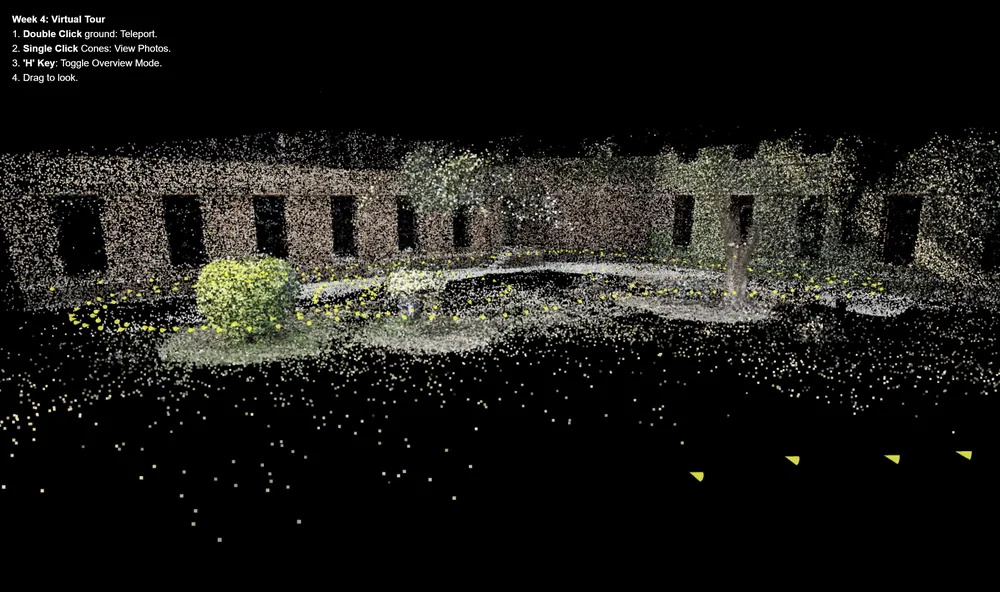
The other half of my work is field phenotyping. I fly drones over crop plots and turn the imagery into plant counts, panicle counts, and elevation models. That work put a first-author paper in Computers and Electronics in Agriculture, and it is what convinced me that the interesting problems are the ones where the sensor is cheap and the environment refuses to cooperate.

I am looking for research positions where I can keep working on embodied perception. If that is your lab, I would like to hear from you.